


How to Evaluate Pillow Support Without Relying on Online Ratings
Online ratings can be helpful when researching a pillow, but a high rating does not necessarily mean a product will be the right choice for every person. Comfort is personal, and different people can have different preferences for firmness, height, shape, and overall support.

Instead of choosing a pillow simply because thousands of people have rated it positively, it can be more useful to understand what its design offers and compare those characteristics with your own requirements.
A thoughtful evaluation can make it easier to narrow down options without depending entirely on popularity.
Start by Understanding What Support Means to You
The word “support” can mean different things to different people.
For one person, support may mean a firmer and more structured feel. Another person may prefer a softer pillow that can adjust more easily to movement.
Before comparing products, think about what you want your pillow to accomplish.
Does your current pillow feel too flat? Does it feel excessively firm? Does it lose its shape? Does the height feel appropriate for your usual sleeping position?
These observations can be more useful than a general product rating because they are based on your own experience.
Consider Your Usual Sleeping Position
Your normal sleeping position can influence which pillow characteristics you prefer.
People who primarily sleep on their side may evaluate pillow height and shape differently from people who usually sleep on their back or stomach.
For side sleepers, the shoulder occupies space between the head and the mattress. As a result, the distance that needs to be supported can vary depending on individual body proportions.
This is one reason that a pillow that feels comfortable to one person may feel different to another.
When comparing the best side sleeper pillow options, look beyond ratings and consider whether the pillow's design, dimensions, and construction are appropriate for your own sleeping habits.
Look at Pillow Height
Pillow height is one of the practical characteristics worth checking.
A pillow that is too low or too high may not feel appropriate for a particular person. However, there is no universal height that automatically works for everyone.
Body proportions, mattress characteristics, sleeping position, and personal preferences can all influence what feels comfortable.
Instead of choosing a pillow because a review says it has the “perfect” height, check the manufacturer's specifications and compare them with what you already know about your preferences.
Examine the Shape
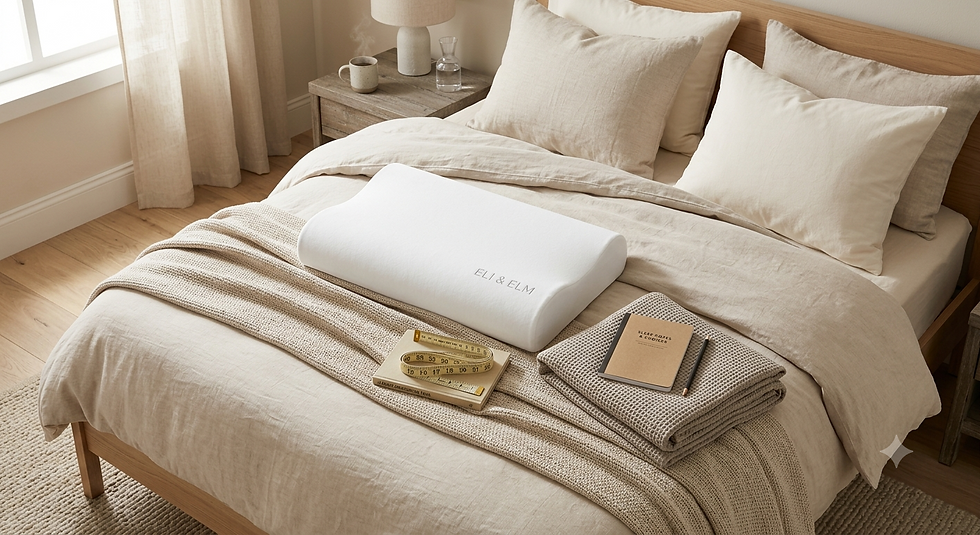
The shape of a pillow can affect how its support is distributed.
Some pillows use a conventional rectangular design, while others have specialized contours or shapes. These differences may influence how the pillow interacts with the head, neck, shoulders, and surrounding sleeping surface.
A product photograph can provide an initial impression, but it does not always communicate how the shape will feel during actual use.
Look at the product description and specifications to understand what the design is intended to do.
Consider Construction Rather Than Marketing Language
Product descriptions often use words such as “supportive,” “comfortable,” or “premium.”
These descriptions can be useful, but they are not measurable characteristics on their own.
Instead, look for details about how the pillow is constructed.
Consider its dimensions, shape, filling or internal structure, cover, firmness information, and any adjustment features provided by the manufacturer.
The more specific information you have, the easier it becomes to compare products objectively.
Use Reviews for Experiences, Not as the Final Decision
This does not mean online reviews are useless.
Reviews can provide valuable information about how different people experience a product. They may reveal practical details that are not immediately obvious from a product description.
However, reviews should be interpreted in context.
If one person says a pillow is very firm, ask whether that person prefers firm pillows. If another reviewer says the pillow feels too low, consider whether their body proportions and sleeping habits are similar to yours.
A review becomes more useful when you can relate the experience to your own circumstances.
Pay Attention to Consistent Patterns
Instead of focusing on one five-star or one negative review, look for recurring observations.
If many reviewers independently mention the same characteristic, that information may deserve more attention.
For example, repeated comments about firmness, shape, size, or construction can help you understand how people commonly experience a product.
Still, repeated feedback does not guarantee that you will have the same experience.
It simply gives you additional information to consider alongside the manufacturer's specifications.
Compare Products Using the Same Criteria
One of the easiest ways to make online research more useful is to compare products using a consistent checklist.
For example, you might compare:
Height
Dimensions
Shape
Firmness
Construction
Material
Cover design
Adjustability
Intended use
Care requirements
Using the same criteria for every product prevents one impressive feature from dominating your decision.
It also makes it easier to identify meaningful differences between products.
Think About Your Existing Sleep Environment
A pillow is used as part of a larger sleep setup.
Your mattress, bedding, sleeping position, and personal habits can all influence how a pillow feels.
This is another reason why online ratings cannot provide a universal answer.
Someone reviewing a pillow may be using it on a different mattress or with different bedding from yours. Their experience can therefore be useful information without being a direct prediction of your own experience.
Think about the conditions in which you will actually use the pillow.
Don't Assume the Most Expensive Option Is the Best
Price can be another misleading factor.
A higher price does not automatically mean a pillow will be more suitable for a particular person.
Likewise, a lower-priced product is not automatically a poor choice.
Instead of using price as a shortcut for quality or suitability, compare the actual characteristics of the products you are considering.
Look at the design, specifications, construction, and intended use.
Then decide whether those characteristics justify the price for your particular requirements.
Think About Long-Term Use
A pillow is usually something that becomes part of a regular routine rather than a product used only once.
For this reason, think about how the pillow is likely to fit into your everyday habits.
Consider whether the design is practical for regular use, whether the cover can be maintained according to the manufacturer's instructions, and whether the pillow's dimensions work with your existing setup.
These considerations may not appear in a simple star rating, but they can influence your overall experience.
Create Your Own Evaluation Checklist
You do not need to become an expert in pillow construction to make a more informed choice.
A simple checklist can be enough.
Before purchasing, ask:
1. What sleeping position do I use most often?
2. What do I like or dislike about my current pillow?
3. What pillow height feels appropriate to me?
4. Do I prefer a softer or more structured feel?
5. Does the product's shape suit my intended use?
6. Are the dimensions clearly provided?
7. Do multiple reviews mention a consistent characteristic?
8. Does the manufacturer's information support what the reviews are saying?
This approach gives you a more balanced way to evaluate a product.
Make Reviews Part of the Research, Not the Research
Online ratings are most useful when they are treated as one source of information rather than the final answer.
Manufacturer specifications tell you what the product is designed and built like. Reviews can tell you how different customers experienced it. Your own preferences determine whether those characteristics are relevant to you.
Combining these three perspectives can provide a more complete picture.
This is especially useful when choosing a pillow because comfort can vary significantly between individuals.
Final Thoughts
Choosing a pillow does not have to come down to finding the product with the highest rating.
A better approach is to understand your own sleeping habits and then compare the characteristics that actually matter to you.
Consider pillow height, shape, construction, dimensions, firmness, and intended use. Use reviews to identify recurring experiences, but interpret those experiences according to your own requirements.
For side sleepers, this approach can be particularly useful because differences in body proportions and sleeping habits can influence how a pillow feels.
Ultimately, the best side sleeper pillow is not necessarily the one with the highest number of reviews or the most impressive marketing claims. It is the option whose design and characteristics make sense for the individual using it.
Taking a few extra minutes to evaluate the product beyond its star rating can lead to a more informed and personalized purchasing decision.


Comments