


Best Pillow for Side Sleepers: Comfort Checklist
Choosing a pillow for side sleeping is not simply a matter of picking the softest option or buying the one that looks most comfortable. A pillow can feel pleasant when you first lie down and still become less comfortable after several hours. The more useful question is whether your current pillow actually fits the way you sleep.
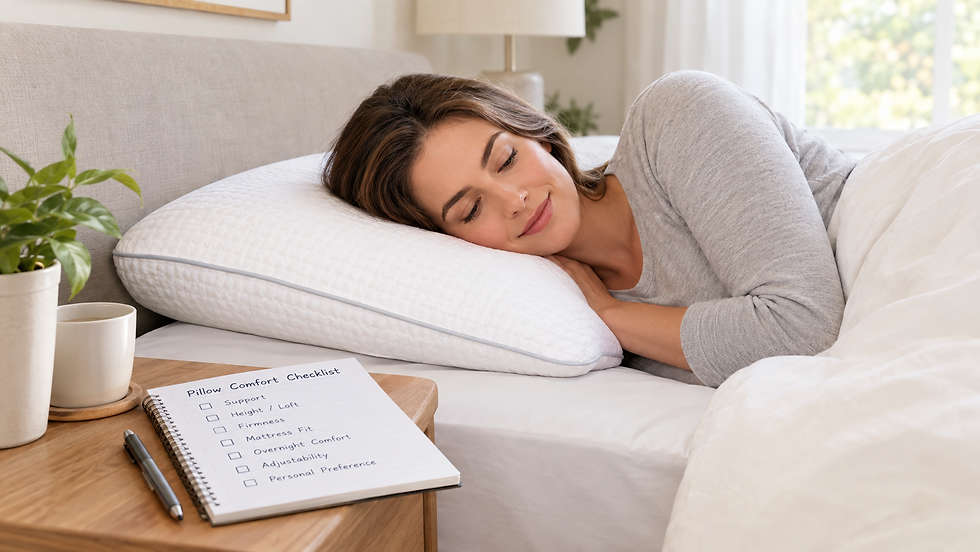
Its height, support, shape, materials, and interaction with your mattress can all influence your overall experience. A practical evaluation can help you identify what is working, what is not, and which characteristics may better suit your sleeping habits.
Start With Your Normal Sleeping Position
Before judging your pillow, start with how you actually sleep.
If you spend most of the night on your side, your head and neck have a different relationship with the mattress than they would when sleeping on your back or stomach. Your shoulder occupies space between your head and the mattress, while the pillow fills the remaining gap.
Your position may also change during the night. Some side sleepers remain mostly on one side, while others move from left to right or briefly shift toward another position.
Think about your normal pattern:
Do you stay on one side for most of the night?
Do you switch sides frequently?
Do you sometimes sleep partly on your stomach?
Do you tend to tuck an arm beneath the pillow?
Do you move your pillow when changing positions?
These habits can influence what type of pillow height, shape, and responsiveness feels natural to you.
Check How Your Head and Neck Feel
A useful side sleeper pillow should feel supportive without making you constantly aware of the support.
When you lie on your side, notice whether your head feels comfortably supported or whether it seems to tilt toward the mattress. Also pay attention to whether the pillow feels excessively high and pushes your head upward.
Your neck and shoulder area can provide useful clues. If you repeatedly feel the need to fold, squeeze, or reposition the pillow to get comfortable, the pillow may not be matching your preferred sleeping position.
This does not automatically mean that a particular pillow is “wrong.” Comfort is personal, and factors such as body proportions, mattress firmness, and sleeping habits all influence how a pillow feels.
Pay Attention to Pillow Height and Loft
Pillow loft refers to the pillow's height or thickness when you are using it. For side sleepers, loft deserves particular attention because the pillow needs to accommodate the space between the head and the mattress.
A pillow that feels comfortable in your hands may behave differently once your head and shoulder are resting on it.
Consider what happens when you lie normally on your side. Does the pillow compress substantially? Does it remain close to its original height? Does your head feel supported without being pushed noticeably upward?
There is no single pillow height that works for every side sleeper. Shoulder width, mattress characteristics, body position, pillow construction, and personal preference can all affect the appropriate loft. The goal is to find a height that feels natural for your individual setup.
Consider Your Mattress and Body Position
Your pillow does not work in isolation.
A softer mattress may allow your shoulder to sink farther into the surface, while a firmer mattress may leave your shoulder closer to the top. That difference can change the distance between your head and the mattress and, consequently, how your pillow feels.
This is why a pillow that works well on one bed may feel different on another.
Your body position matters, too. A person with broader shoulders may prefer a different pillow height from someone with narrower shoulders. Someone who remains still throughout most of the night may have different requirements from someone who changes positions frequently.
Instead of evaluating the pillow by its advertised specifications alone, evaluate it as part of your complete sleep setup.
Evaluate the Pillow After Several Hours of Sleep
A five-minute test can tell you whether the surface feels pleasant. It cannot always tell you how the pillow will feel after several hours of normal movement.
Pay attention to what happens during the middle of the night and when you wake up. Do you regularly pull the pillow closer? Fold it? Flip it over? Push it away? Search for a different position?
These behaviors do not necessarily mean a pillow is unsuitable, but repeated adjustments can reveal useful information about your preferences.
For a broader look at how a pillow behaves during the night, consider how movement, materials, construction, and pressure can change the way a pillow feels over several hours.
The important point is to evaluate actual use rather than relying entirely on first impressions.
Look Beyond Softness and Firmness
“Soft” and “firm” are useful descriptions, but they do not tell the whole story.
Two pillows with similar firmness ratings can feel very different because of their materials, internal construction, shape, density, and ability to respond to movement.
Some sleepers prefer a pillow that compresses easily and feels plush. Others prefer a more responsive surface that returns to shape quickly. Some like a structured pillow that stays relatively stable, while others prefer something that can be molded throughout the night.
Firmness and support are also not identical. A softer pillow can still feel supportive to one person, while a firmer pillow may feel uncomfortable to another.
Think about the type of response you prefer rather than selecting a pillow based on one descriptive word.
Consider Your Overall Sleep Routine
Pillow choice is only one part of a comfortable sleep environment.
Your bedtime routine, mattress, bedding, room temperature, and sleeping habits can all influence how your sleep setup feels. If you regularly use a phone or computer immediately before bed, for example, your overall routine may be worth considering alongside your pillow choice.
This discussion of bedtime habits and sleep environment offers another perspective on how the pillow fits into the larger nighttime routine.
The goal is not to change everything at once. Instead, pay attention to the parts of your routine that consistently affect your comfort.
Use a Simple Side Sleeper Pillow Checklist
When evaluating your current pillow, ask yourself:
Does my head feel naturally supported when I lie on my side?
Does the pillow provide enough height without feeling excessive?
Does the loft remain reasonably consistent during the night?
Do I frequently need to reposition or reshape it?
Does it work comfortably with my current mattress?
Do I prefer its softness, firmness, or responsiveness?
Does the shape suit the way I normally position my head and shoulder?
If it is adjustable, can I fine-tune the amount of fill?
Does the pillow remain comfortable after several hours?
Has my preferred feel changed over time?
You do not need every answer to be perfect. The checklist is simply a practical way to identify patterns.
When It May Be Time to Try a Different Pillow
A pillow may be worth reconsidering when its characteristics no longer match your sleeping habits.
Frequent repositioning is one possible sign. So is consistently feeling that the pillow is too high, too low, too soft, or too structured. A pillow that has become uneven or flattened may also feel different from when you first purchased it.
Changes in your mattress, sleeping position, or personal preferences can matter as well. A pillow that once felt comfortable may not feel the same after a change in your sleep setup.
Rather than immediately replacing a pillow based on one uncomfortable night, look for repeated patterns over time.
Explore Different Pillow Options
Once you understand what your current pillow is doing well—and where it falls short—you can make a more informed comparison between different designs.
For example, someone who wants a purpose-designed shape for side sleeping may want to investigate the best pillow for side sleepers while paying attention to its construction, loft, fill options, and overall design rather than assuming that a specialized label guarantees a personal fit.
The Eli & Elm Side Sleeper Pillow currently uses a U-shaped design and offers latex noodle or shredded memory foam fill, with an adjustable liner that allows sleepers to modify the amount of fill. Those characteristics may be useful to someone specifically looking for a more customizable side-sleeping setup, but whether they feel right ultimately depends on individual preferences and sleeping habits.
For a broader explanation of loft, materials, pillow height, and other selection factors, the side sleeper pillow guide can provide additional context.
Final Thoughts
Finding a comfortable pillow for side sleeping is less about identifying a universally perfect product and more about understanding your own sleep setup.
Pay attention to how your head and neck feel, whether the pillow maintains a suitable loft, how it interacts with your mattress, and whether its firmness and responsiveness match your preferences. Most importantly, evaluate the pillow after real nights of sleep rather than relying only on a short test.
Your ideal pillow may also change as your preferences, mattress, or sleeping habits change. Even when researching everyday pillow comfort, the same principle applies: construction, materials, frequency of use, sleeping position, and personal comfort all deserve consideration.
The right side sleeper pillow is ultimately the one whose characteristics make sense for you—and whose support feels natural enough that you can stop thinking about the pillow and focus on getting comfortable.


Comments