


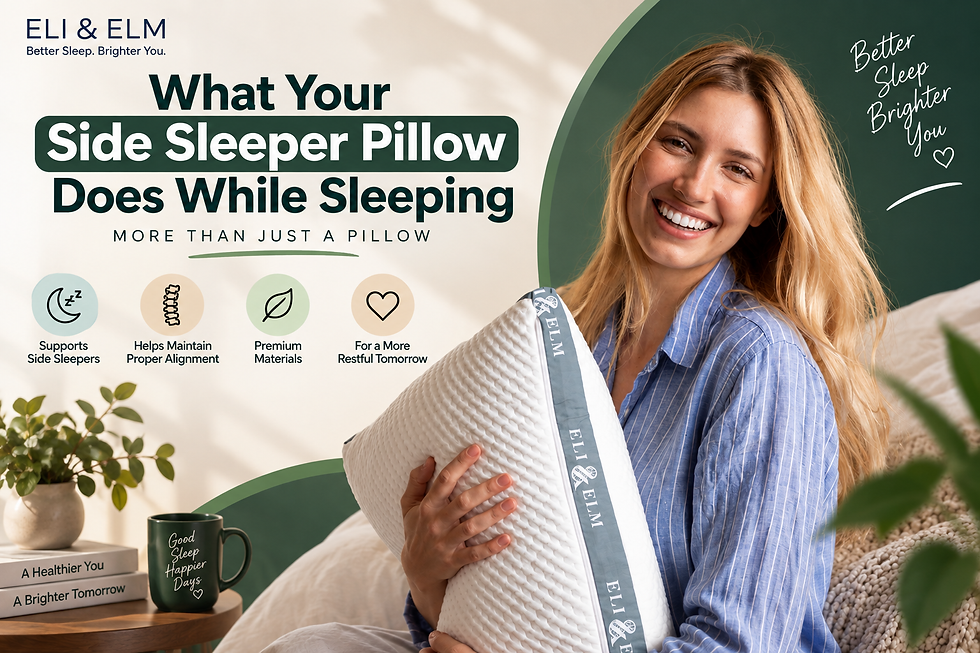
What Your Side Sleeper Pillow Does While Sleeping
You can test a pillow for five minutes.
You can squeeze it, press your hand into it, lie down on it, and decide whether it feels comfortable.
But there is one problem.
You don't sleep for five minutes.
You sleep for hours.
And during those hours, your pillow is doing something very different from what it does while you're standing in a bedroom looking at it.
Your head moves. Your shoulders shift. You change positions. The pillow compresses and recovers. Your bedroom temperature changes. Even the way you settle into the mattress can change how the pillow feels.
This is particularly interesting if you spend most of the night on your side.
So when you're comparing a side sleeper pillow, perhaps the better question isn't simply, “How does it feel right now?”
It's:
“What will it be like after I've been sleeping on it for several hours?”
A Side Sleeper Pillow Has a Night Shift
During the day, a pillow just sits there.
At night, it has a job.
Your head rests against it while your body relaxes. As you move, the pillow responds to pressure. If you turn slightly, the pressure points change. If your shoulder moves closer to the pillow, the available space changes again.
None of this is unusual.
It's simply what happens when a static object becomes part of a moving sleep environment.
That's why side sleeper pillows can feel different depending on how someone actually sleeps rather than how they look on a product page.
A pillow doesn't experience your sleeping position as a label.
It experiences pressure, movement and contact.
The First Impression Isn't Always the Full Story
Imagine trying on a pair of shoes for thirty seconds.
They feel great.
Would you automatically assume they would feel exactly the same after walking in them for eight hours?
Probably not.
Pillows deserve a similar perspective.
The first few minutes can tell you whether the surface feels pleasant, but longer use tells you more about how the pillow behaves.
You may discover that you prefer:
A pillow that keeps its general shape
A surface that responds quickly to movement
A softer or more structured feel
A pillow that doesn't require frequent repositioning
A design that works naturally with your sleeping position
These aren't universal rules.
They're observations about how different sleepers interact with their pillows.
What Happens When a Side Sleeper Moves?
Side sleeping isn't a frozen position.
Even if you consider yourself a dedicated side sleeper, you probably make small movements throughout the night.
Your head may move forward.
Your shoulder may roll slightly.
Your arm may change position.
You may turn toward your stomach for a few minutes and then return to your side.
These movements change how your head interacts with the pillow.
This is why choosing a pillow for side sleepers shouldn't be based only on a photograph showing someone lying perfectly still.
Real sleep is much less organized.
The Material Has a Bigger Role Than You Might Expect
Here's where things get interesting.
Two pillows can have almost identical dimensions but behave very differently because of what's inside them.

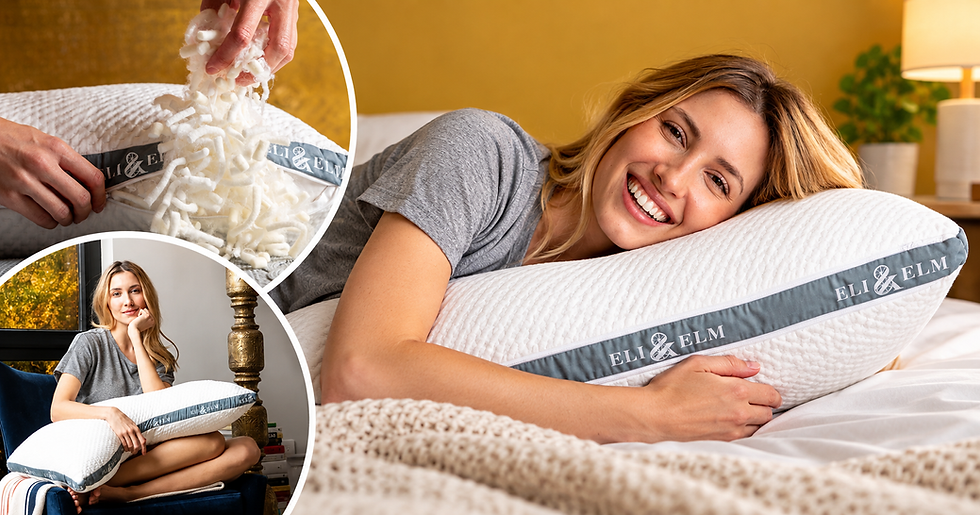
Memory foam, shredded foam, latex, fiber and other materials don't respond to pressure in exactly the same way.
Some materials compress more easily.
Others respond more quickly.
Some designs are structured, while others allow more movement.
And the material itself is only part of the story. Density, construction, cover fabric and ventilation can also influence how a pillow feels.
If you're interested in the broader question of everyday pillow performance, this guide to best everyday pillows for daily sleep comfort offers another perspective on materials, shape, maintenance and regular use.
Why “Soft” Doesn't Tell You Enough
“Soft” sounds simple.
But what does soft actually mean?
Does the pillow compress immediately?
Does it slowly sink?
Does it recover quickly?
Does it remain relatively stable when you move?
Two pillows can both be described as soft and still produce very different experiences.
The same applies to firm pillows.
This is why shopping for the best side sleeper pillow based on a single adjective can be frustrating.
Instead, think about the type of response you personally prefer.
Do you like the pillow to move with you?
Do you prefer it to feel more stable?
Do you like a surface that changes shape easily?
Those questions are more useful than simply asking whether something is “soft” or “firm.”
Your Pillow and Mattress Are Having a Conversation
Here's a detail many people overlook.
Your pillow doesn't work independently of your mattress.
When you lie on your side, your shoulder interacts with the mattress. How much your shoulder sinks can change the distance between your head and the mattress.
That can change how your pillow feels.
Switch to a different mattress and the same pillow may suddenly seem different.
This doesn't necessarily mean the pillow changed.
The relationship between your body, mattress and pillow changed.
That's one reason personal experience matters so much when comparing pillows.
The Pillowcase Is Part of the Experience Too
The pillow itself gets most of the attention.
But the pillowcase sits directly between you and the pillow.
Different fabrics can have different textures and levels of friction. Some may feel smoother, while others may feel more substantial.
A pillow can therefore feel slightly different depending on the cover placed over it.
This is a small detail, but it's exactly the kind of detail people tend to notice only after using a pillow regularly.
Don't Ignore What Happens During the Middle of the Night
Most pillow comparisons focus on bedtime.
But midnight can tell you more.
If you wake briefly, what do you do first?
Do you leave the pillow exactly where it is?
Do you pull it closer?
Do you flip it?
Do you reshape it?
Do you push it away?
These little behaviors can reveal preferences that aren't obvious when you're consciously testing a pillow.
They don't automatically indicate that something is wrong.
They simply show how you naturally interact with your sleep setup.
For more discussion about daily pillow use, you can also explore best everyday pillows for daily sleep comfort.
A Good Pillow Doesn't Have to Feel Dramatic
There's an interesting trap in the pillow market.
People sometimes expect a new pillow to feel dramatically different.
But comfort doesn't always announce itself.
A pillow that suits you may simply become something you stop thinking about.
You don't constantly move it.
You don't spend several minutes arranging it.
You don't notice it during every position change.
It simply becomes part of your normal sleeping environment.
That can be more meaningful than a pillow that feels impressive for the first ten minutes.
What Makes a Pillow Feel Natural for Side Sleepers?
There isn't one universal answer.
A useful side sleeper pillow is ultimately one whose characteristics make sense for the person using it.
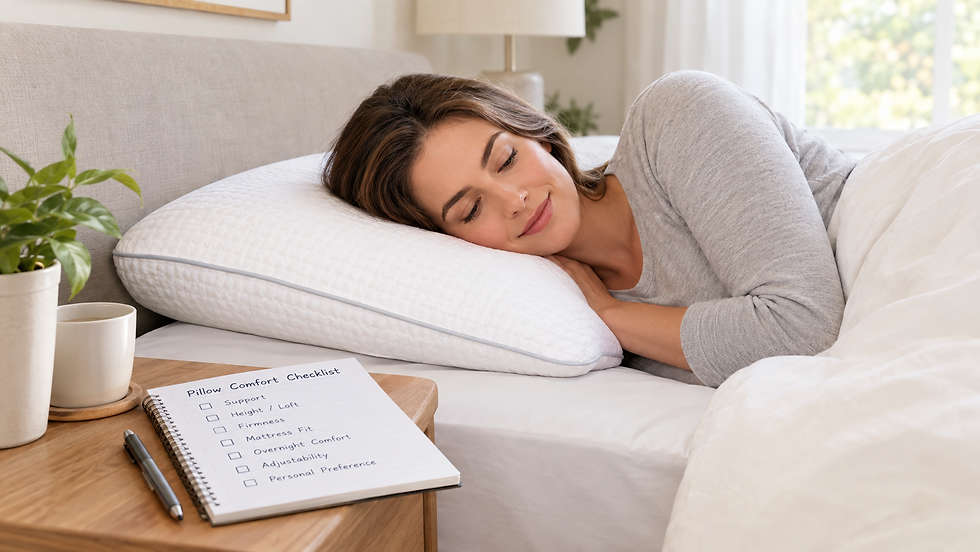
You might consider:
How you normally sleep
How much you move during the night
The feel you prefer
The material inside the pillow
How the pillow responds to pressure
Whether the shape remains reasonably consistent
How it works with your mattress
Whether the cover feels comfortable
How much maintenance it requires
These factors don't have to be evaluated like a complicated scientific experiment.
They are simply practical details.
What About Neck and Shoulder Comfort?
This is where many people immediately jump to the conclusion that they need a particular type of pillow.

But neck and shoulder comfort is influenced by more than the pillow alone.
Sleeping position, mattress characteristics, body position and individual preferences all matter.
Your existing guide on side sleeper pillow, neck and shoulder comfort goes deeper into those considerations.
The useful takeaway is simple:
Don't judge a pillow by one feature alone.
Look at the whole sleeping setup.
The Best Pillow Question Isn't “Which One Is Best?”
It's tempting to search for the best side sleeper pillow and expect Google to give you one definitive answer.
But “best” depends on the person asking the question.
Someone who likes a soft, flexible feel may have completely different priorities from someone who prefers a more structured pillow.
Someone who rarely moves during sleep may evaluate a pillow differently from someone who changes positions frequently.
And someone sleeping on a soft mattress may experience the same pillow differently from someone using a firmer mattress.
So instead of asking:
“Which pillow is the best?”
try asking:
“Which characteristics make sense for the way I sleep?”
That's a much more useful question.
When You're Ready to Compare Side Sleeper Pillows
Once you understand your own preferences, comparing products becomes easier.
You can look at the construction instead of just the marketing language.
You can compare materials.
You can consider the shape.
You can read the care instructions.
You can think about your mattress and sleeping habits.
And if you're specifically researching designs made for side sleeping, you can look at the specifications of a side sleeper pillow and decide whether those characteristics match what you're looking for.
The important part is to evaluate the characteristics rather than assume a product is automatically right for everyone.
Final Thoughts
A pillow may look like a simple piece of bedding.
But once the lights go out, it becomes part of a much more complicated environment involving your body, mattress, sleeping position, movement, materials and personal preferences.
That's why a five-minute test can only tell you so much.
The real experience happens over time.
If you're a side sleeper, pay attention not only to how a pillow feels when you first lie down, but also to how naturally it fits into the way you actually sleep.
Because the most useful pillow isn't necessarily the one that makes the biggest impression.
It may simply be the one you stop noticing once you're asleep.
Comments